
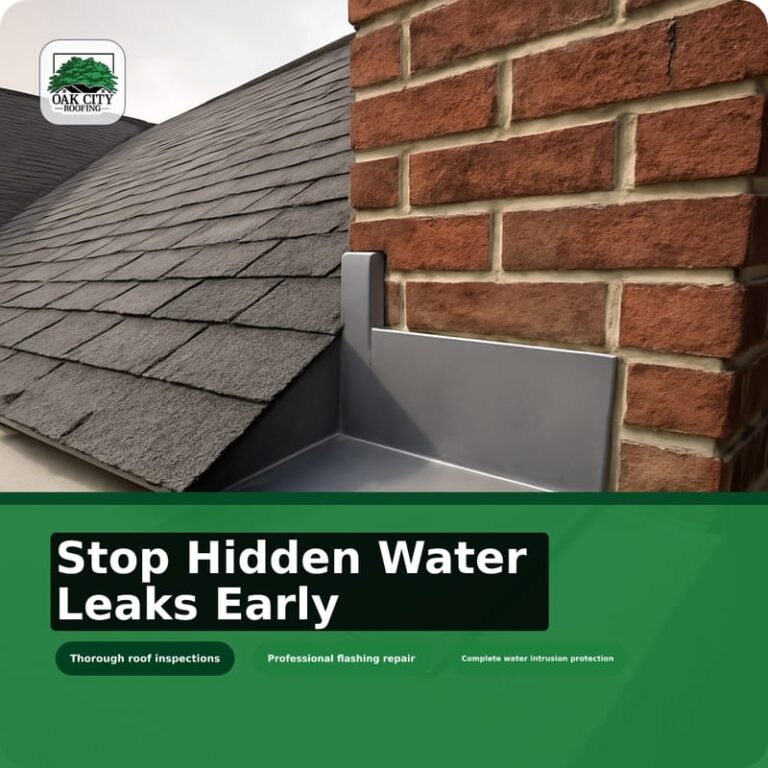
The Silent Guardian of Your Home’s Structural Integrity
When most homeowners picture a secure roof, they visualize sturdy shingles or thick metal panels blocking out the elements. However, the most vulnerable points on any roof are not the flat surfaces, but the joints, valleys, and intersections where different planes meet.
This is where high-performance roof flashing comes into play as your home’s primary barrier against targeted water entry. Installed around chimneys, skylights, dormers, and vent pipes, these thin metal strips direct heavy rainfall away from vulnerable seams and safely down toward your gutter system.
At Oak City Roofing, we frequently observe that structural water damage begins long before a single shingle shows signs of wear. Understanding how these critical metal barriers function—and why they fail—is essential for every homeowner looking to preserve their property value.
Understanding How Roof Flashing Channels Water Away
Water always follows the path of least resistance, especially during heavy downpours accompanied by high winds. Without properly integrated sheet metal, water quickly seeps into the interior joints of your home’s roof deck, leading to hidden rot and costly repairs.
Industry research shows that the vast majority of residential roof leaks originate at junction points rather than across the main field of shingles. Custom-fitted metal seals prevent this by creating a watertight bridge between roofing materials and vertical surfaces like walls or chimneys.
The Key Types of Protective Metal Strips
- Step Flashing: L-shaped metal pieces overlaid in overlapping layers alongside walls and dormers to step water down the roof slope.
- Counter Flashing: Durable metal sections installed directly into masonry mortar joints to cap over step pieces and prevent top-edge water intrusion.
- Valley Flashing: Broad metal channels placed in the internal angles where two roof slopes meet to handle massive volumes of runoff water.
- Drip Edges: Specialized metal strips installed along roof eaves and rakes to guide water away from the fascia board and underlying wood deck.
The Hidden Challenges That Cause Metal Sealing Failures
Because these metal components are tucked beneath shingles or mortared into brickwork, defects are extraordinarily difficult for the untrained eye to spot. Over time, constant thermal expansion and contraction cause different building materials to shift at varying rates.
This thermal movement exerts severe stress on sealant joints and mechanical fasteners, eventually creating hairline gaps. When water enters these microscopic openings, it bypasses the surface layer completely and begins saturating the internal framework of your home.
Corrosion and Material Incompatibility
Mixing incompatible metals can trigger a severe biochemical reaction known as galvanic corrosion. For instance, pairing copper components directly with aluminum or steel fasteners rapidly accelerates the decay of the metal strips, leading to premature failure.
Furthermore, standard air pollution and chemical runoff from degrading asphalt shingles gradually eat away at protective metal coatings. Once the base metal oxidizes, rust holes form out of sight beneath the top layer of shingles.
Improper Installation Techniques and Caulk Overuse
A common mistake made during budget installations is relying on temporary caulking or liquid sealants instead of traditional, mechanically layered metal fitting. Caulk degrades rapidly when exposed to harsh ultraviolet radiation and dramatic temperature swings.
Properly integrated roof flashing relies on gravity and precision overlap geometry—not short-term adhesive tubes—to shed water efficiently. When installer craft is lacking, water eventually pools behind the metal lip, causing widespread wood sheath decay.
Key Signs Your Exterior Joints Need Immediate Attention
Detecting junction damage early allows you to address localized defects before structural timber frame rot sets in. Homeowners should perform visual checks from ground level twice a year and after severe windstorms.
Indoor Visual Clues
Keep a close eye on ceilings and interior walls immediately adjacent to exterior vertical structures like chimneys or upper-story walls. Discolored water rings, peeling paint, or bulging drywall near these intersections strongly suggest that joint seal integrity has failed upstairs.
Exterior Red Flags
Inspect vertical brickwork for flaking mortar or loose metal plates that appear to have pulled away from the wall. If you spot rusted trim, missing counter sections, or buckled valley metals, moisture is almost certainly penetrating your outer defense layers.
Proactive Maintenance Protects Your Investment
Routine roof maintenance should always include a detailed evaluation of all high-stress seams and metal transitions. Catching corroded metal strips early prevents deep structural rot, mold proliferation, and compromised interior drywall.
Experts recommend scheduling professional assessments at least once every few years, particularly as asphalt shingles reach the midpoint of their operational lifespan. Replacing worn joint trim during routine upkeep is exponentially less expensive than rebuilding a rotted structural roof deck.
If you suspect water is infiltrating your home’s exterior transitions or wish to evaluate your home’s weather defense system, explore our related guide on identifying early structural roof damage or reach out to the professional team at Oak City Roofing today for a comprehensive evaluation.